
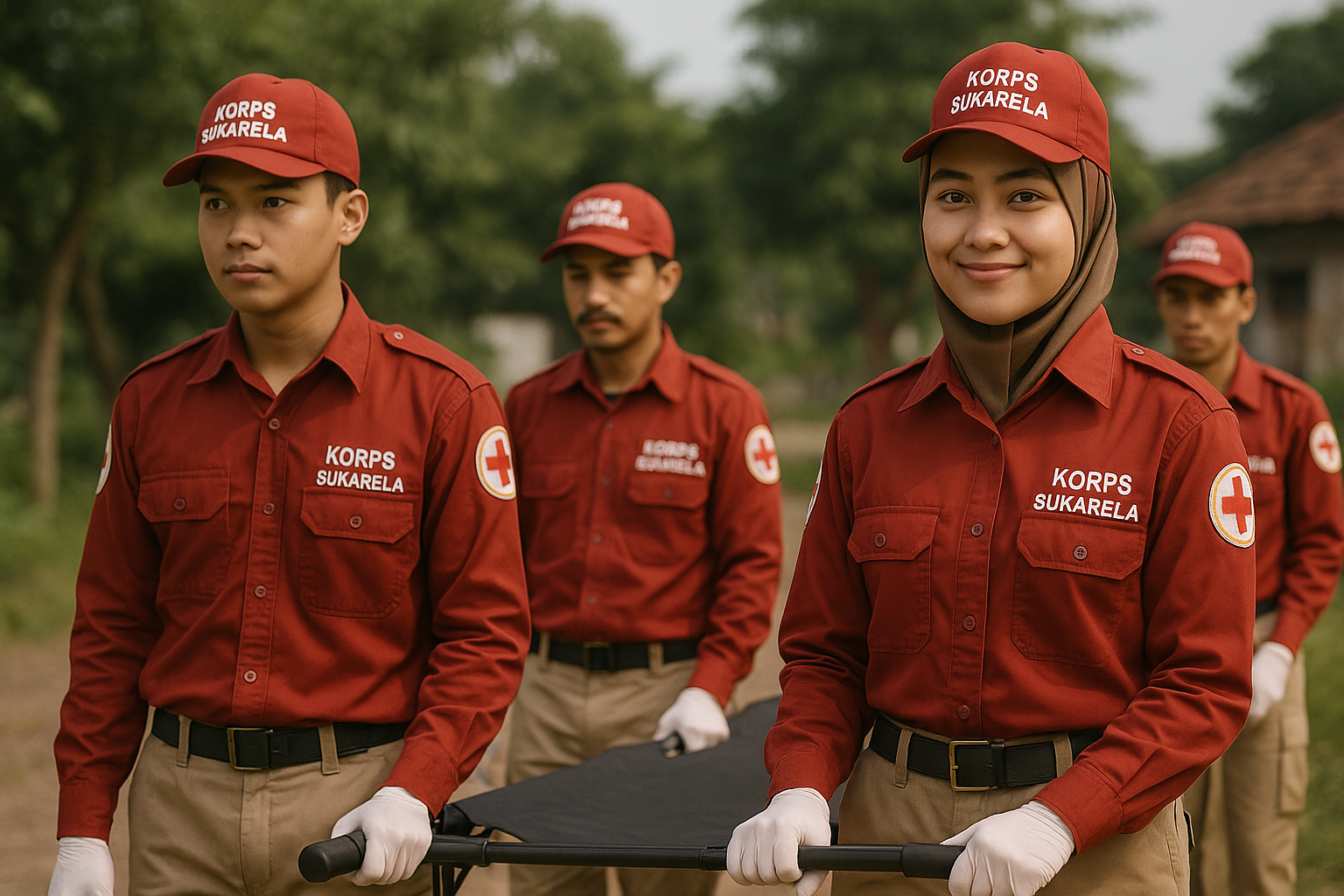
With over 58,000 active members spread across cities, regencies, and university campuses, KSR forms the frontline human infrastructure of Indonesia’s emergency response system. These are not casual helpers. Every member completes a formal training curriculum before deployment. They follow the Seven Fundamental Principles of the International Red Cross and Red Crescent Movement — humanity, impartiality, neutrality, independence, voluntary service, unity, and universality. That framework is what separates Korps Sukarela from ad-hoc community goodwill and makes it a trusted, reliable force during the worst moments communities face.
The overview table below captures the essential facts at a glance before we go deeper into what makes this organization so significant.
| Full Name | Korps Sukarela (KSR) |
|---|---|
| Translation | Volunteer Corps |
| Parent Organization | Palang Merah Indonesia (PMI) — Indonesian Red Cross |
| Founded | Mid-20th century; formalized alongside PMI (est. 1945) |
| Active Members | 58,000+ across Indonesia |
| Membership Age | 18 years and above |
| Cultural Foundation | Gotong royong (mutual community cooperation) |
| Core Activities | Disaster response, first aid, blood drives, health education, social welfare |
| Training Levels | Basic (Diklat), Advanced, Specialization (Satgana) |
| Volunteer Pay | Unpaid; small allowance during extended disaster deployments only |
| University Presence | Active student units (UKM KSR PMI) across Indonesian universities |
| International Affiliation | International Red Cross and Red Crescent Movement |
The Cultural Root: Gotong Royong
To understand Korps Sukarela, you have to understand gotong royong first. This Indonesian phrase — roughly meaning “mutual cooperation” or “collective effort” — is one of the most deeply held values in Indonesian society. For generations, communities across the archipelago have practiced it informally: neighbors pooling labor to rebuild a home after a flood, villages sharing resources after a harvest fails, families supporting one another through illness without any formal structure or expectation of return. It is community care as a way of life, not a policy.
Korps Sukarela is what happens when that instinct gets organized. PMI recognized early on that Indonesia’s geography — a sprawling archipelago of over 17,000 islands sitting on the Pacific Ring of Fire — made informal community response insufficient for the scale of disasters the country regularly faces. Earthquakes, tsunamis, volcanic eruptions, floods, and landslides are not rare events here. They are recurring realities. The spirit of gotong royong needed a training curriculum, a deployment structure, and a communication system to be genuinely effective at scale. KSR became that structure.
This cultural grounding is not a branding exercise. It is the reason KSR volunteers show up without pay, often at personal risk, and sustain engagement over years rather than treating volunteering as a one-time activity. The organization taps into something that already exists in Indonesian identity and gives it a form capable of functioning under pressure.
How KSR Connects to PMI
PMI — Palang Merah Indonesia — is Indonesia’s national Red Cross society, founded in 1945 during the country’s independence struggle. It operates across disaster response, blood services, health support, and social welfare programs, and it is one of the largest humanitarian organizations in Southeast Asia. KSR sits within this structure as the primary volunteer arm: the human force that carries PMI’s mission into communities and emergency zones.
The relationship matters for practical reasons. Because KSR members operate under PMI’s organizational structure, they are not working in isolation. They are connected to local PMI branches at the city, regency, and provincial levels. This means that when a disaster strikes, KSR units can be mobilized through existing channels, supplied through PMI’s logistics networks, and coordinated across regions without starting from scratch. It also means their work carries institutional credibility — communities and government agencies trust a PMI volunteer in a way they might not trust an unaffiliated helper.
University-based units, known as UKM KSR PMI, are among the most active in the country. Campuses at institutions like Universitas Esa Unggul, Universitas Muhammadiyah Malang, and Universitas Negeri Malang host student chapters that run their own training programs, blood drives, and community outreach activities. These units serve as the primary entry point for young Indonesians into organized humanitarian service and have produced a generation of volunteers who carry those skills into professional careers in medicine, nursing, community development, and public policy.
What KSR Volunteers Actually Do
The scope of KSR activity extends well beyond emergency response, though that is often the most visible part of their work. On any given week, across Indonesia, KSR members are doing things that rarely make headlines but keep communities measurably healthier and more resilient.
Disaster Response and First Aid
This is the work most people associate with KSR. When earthquakes, floods, tsunamis, or landslides strike, KSR volunteers are typically among the first responders on the ground — deploying before national relief agencies have fully mobilized. They assist with evacuation of affected populations, provide immediate first aid, set up emergency shelters, distribute clean water and food supplies, and help restore family connections through PMI’s Restoring Family Links (RFL) program. Their speed matters enormously. In the critical hours after a disaster, trained volunteers with local knowledge save lives that centralized response systems would reach too late.
Blood Donation and Public Health
Indonesia requires an estimated 5 million blood bags annually to meet national medical needs. KSR volunteers are instrumental in organizing and running the donation drives that supply a significant share of that demand. Beyond blood services, they run community health education programs covering hygiene, disease prevention, nutrition, and vaccination campaign support. Peer counseling programs address HIV/AIDS awareness, substance misuse prevention, and mental health among youth. For many rural Indonesians, a KSR health outreach visit represents their only healthcare contact for months at a stretch.
Social Welfare and Community Programs
KSR’s non-emergency work includes outreach to orphanages and elderly care facilities, neighborhood cleanups, and collaboration with local governments on social welfare initiatives. University KSR units often run peer education campaigns on their campuses that extend into surrounding communities. This consistent, non-crisis presence is what gives KSR its deep community roots — and what makes their disaster response so effective when it is needed.
| Activity Area | Key Tasks | When Active |
|---|---|---|
| Disaster Response | Evacuation, first aid, shelter setup, RFL, supply distribution | Emergency deployments |
| Blood Services | Organizing donation drives, donor recruitment, blood bank support | Year-round |
| Public Health | Hygiene education, vaccination support, disease prevention campaigns | Year-round |
| Youth Counseling | HIV/AIDS awareness, substance misuse prevention, peer support | Year-round |
| Social Welfare | Orphanage/elderly outreach, neighborhood programs, community cleanups | Year-round |
| Training & Drills | Regular refresher courses, simulations, new member education | Ongoing |
Real Disasters Where KSR Made the Difference
Numbers tell part of the story. Real deployments tell the rest. Indonesia’s position on the Ring of Fire means KSR volunteers face genuinely catastrophic conditions on a recurring basis — not theoretical training scenarios but actual mass casualty events requiring sustained, coordinated response.
2018 Sulawesi Earthquake and Tsunami
When a 7.5-magnitude earthquake triggered a devastating tsunami in Palu, Central Sulawesi in September 2018, KSR volunteers were among the first organized responders on the ground. With official infrastructure severely damaged and communication lines down, local KSR units — drawing on their community-embedded knowledge — navigated to affected neighborhoods before national response systems reached full operational capacity. They pulled survivors from rubble, established emergency shelters, and distributed clean water to tens of thousands of displaced residents during the critical early hours.
2022 Cianjur Earthquake
A 5.6-magnitude earthquake struck Cianjur, West Java in November 2022, killing over 300 people and displacing more than 100,000. KSR units from local PMI branches and nearby university chapters mobilized rapidly, providing first aid, evacuation assistance, and psychosocial support to affected communities. Their ability to coordinate with PMI’s logistics infrastructure allowed for sustained operations across multiple weeks — a scale of commitment that distinguishes organized volunteer corps from spontaneous community helpers.
These deployments illustrate a consistent pattern: KSR’s value is not just in what members can do individually but in their ability to function as a coordinated system under extreme pressure. Training, structure, and the PMI institutional connection make that possible.
Training Levels and How to Join KSR
Joining Korps Sukarela is a structured process — deliberately so. The organization’s effectiveness depends on every member meeting a common standard of training before deployment. Casual interest is welcome at the door, but actual membership requires completing the Basic Education program (Diklat Dasar), which covers over 120 hours of instruction across first aid, evacuation procedures, PMI organizational principles, and Red Cross ethical codes.
Basic Eligibility Requirements
To join, applicants must be at least 18 years of age, possess a minimum junior high school education, be Indonesian nationals or legal residents with valid documentation, and demonstrate willingness to train and follow organizational rules. Foreign nationals residing legally in Indonesia are eligible. The SIAMO app is now used for digital registration and activation, with verification processed through local PMI branches within approximately two weeks.
Training Levels
After completing basic training, members can progress through Advanced Training — which deepens skills in disaster management, psychosocial support, and community health — and then to Specialization (Satgana), a rapid-response track for members who want professional-grade readiness for major national emergencies. Digital training tools and virtual drill applications were introduced post-COVID and are now integrated into the standard curriculum. University units offer campus-based entry points and often run their own recruitment drives at the start of each academic year.
| Level | Duration | Key Content | Who It’s For |
|---|---|---|---|
| Basic (Diklat Dasar) | 120+ hours | First aid, evacuation, PMI principles, Red Cross ethics | All new members |
| Advanced Training | Varies by unit | Disaster management, psychosocial support, health programs | Active members post-basic |
| Specialization (Satgana) | Intensive | Rapid response, mass casualty management, logistics | Experienced members seeking field leadership |
| Refresher / Drills | Ongoing | Skill maintenance, new protocol updates, simulation exercises | All active members |
KSR vs. Other Volunteer Organizations
A common source of confusion — particularly outside Indonesia — is the difference between KSR and similar-sounding organizations in neighboring countries. The most frequent mix-up is with RELA (Ikatan Relawan Rakyat), Malaysia’s Volunteers Corps Department. While both operate under government-adjacent structures and carry “volunteer” in their name, their mandates are fundamentally different. KSR is a humanitarian force focused on disaster relief and community health. RELA is a Malaysian civil security auxiliary operating under the Ministry of Home Affairs, focused on public order and national security. Different missions, different values, different legal powers.
| Organization | Country | Parent Body | Primary Mission | Paid? |
|---|---|---|---|---|
| Korps Sukarela (KSR) | Indonesia | PMI (Red Cross) | Humanitarian: disaster, health, welfare | No |
| RELA | Malaysia | Ministry of Home Affairs | Civil security auxiliary | No |
| Philippine Red Cross Volunteers | Philippines | Philippine Red Cross | Humanitarian: disaster, health | No |
| CERT (USA) | United States | FEMA / local government | Community emergency response training | No |
| St John Ambulance | Multiple countries | Order of St John | First aid, health services | No |
Within Indonesia itself, KSR is distinguished from other volunteer groups by the depth of its training standards, its direct integration with PMI’s operational infrastructure, and its affiliation with the global International Red Cross and Red Crescent Movement. That international backing provides access to shared protocols, international disaster relief networks, and cross-border cooperation during major regional crises.
Challenges Facing KSR Today
KSR’s scale and impact are real — but so are the pressures the organization faces. Honest assessment of these challenges is part of understanding what support the organization actually needs to sustain its mission going forward.
Time constraints affect the majority of members, particularly students balancing academic demands with volunteer commitments. Funding limitations at the unit level mean many local chapters rely on minimal institutional budgets, which constrains training quality, equipment access, and the frequency of community outreach programs. Public awareness of what KSR does — and how to access their services — remains uneven, particularly in rural areas where their presence could make the greatest difference.
Perhaps most underacknowledged is the emotional toll of sustained disaster response work. Volunteers who regularly respond to mass casualty events, who sit with grieving families and process traumatic scenes as part of their routine service, face real psychological burdens. The organization is increasingly aware of this and has begun integrating psychosocial support for volunteers themselves — not just the communities they serve. This is a necessary evolution for any humanitarian organization that wants to retain experienced members over the long term.
Technology is also reshaping what effective volunteering looks like. The introduction of digital registration through the SIAMO app and virtual drill platforms represents a positive adaptation, but sustained investment in digital tools and training infrastructure will be essential to keep KSR competitive with the demands of modern emergency response.
