
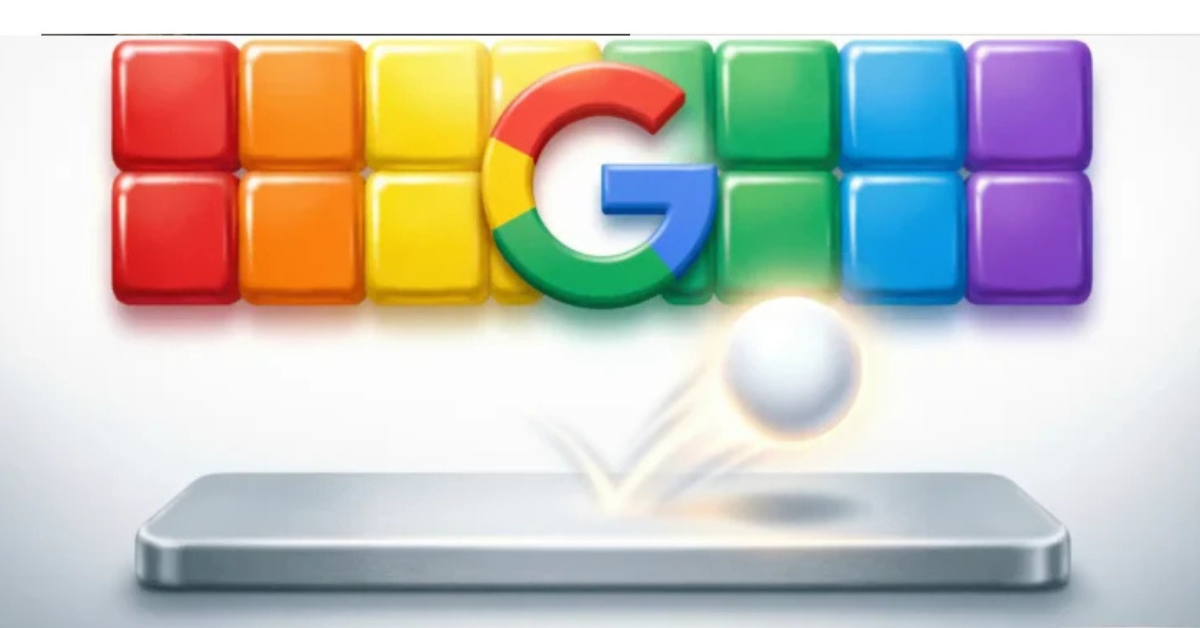
Google Block Breaker is a free, browser-based arcade game built directly into Google Search. Officially launched in January 2025, it is a modern version of the classic Atari Breakout — you control a paddle to bounce a ball and smash coloured bricks across 150 levels. To play, simply type “Block Breaker” into Google Search and click the Play button that appears at the top of the results. No download, no account, no cost — it works on desktop and mobile instantly.
What Is Google Block Breaker?
Google Block Breaker is one of the most satisfying things Google has ever quietly hidden inside its search results. It is a fully playable arcade game that loads directly in your browser when you type the right search query — no app store visit, no account creation, no loading screen that outlasts your patience. You type two words. You click play. You are immediately knocking a ball into coloured bricks while your paddle slides across the bottom of the screen. The entire setup takes less time than boiling a kettle.
The game is a modern reimagining of Atari Breakout, the legendary 1976 arcade cabinet that helped define the earliest era of video gaming. Google’s version keeps the core formula intact — ball, paddle, bricks, points — and adds structured levels, power-ups, multiple balls, indestructible blocks, and both light and dark visual themes. It is simultaneously a nostalgia machine for anyone who remembers feeding coins into arcade cabinets and a genuinely enjoyable game for anyone discovering the genre for the first time.
Google has been experimenting with this concept since 2013, when a hidden Easter egg in Google Image Search transformed search result thumbnails into a playable Breakout board. That version disappeared in 2020. The January 2025 release replaced it with something considerably more polished — a proper game with progression, varied level designs, and the kind of careful tuning that makes it as easy to pick up for five minutes as it is to lose forty-five minutes to without noticing.
| Feature | Value |
|---|---|
| Total Levels | 150 |
| Starting Lives | 3 |
| Original Easter Egg | 2013 |
| Official Launch | Jan 2025 |
How to Find and Play Google Block Breaker
Finding Google Block Breaker is one of the most straightforward things you will do today. Google designed the game to be immediately accessible — no hidden menus, no obscure navigation, no prerequisite knowledge required. Here is how to get from your browser to your first serve in under sixty seconds.
- Open Google Search — in any browser on desktop, laptop, tablet, or phone. The game works on all of them.
- Type “Block Breaker” into the search bar — no quotation marks needed. Hit Enter.
- Find the game card — it appears near the top of the results as a colourful interactive panel. It looks different from standard search results and has a clearly visible Play button.
- Click or tap Play — the game loads immediately. On desktop, use your mouse or arrow keys to control the paddle. On mobile, swipe your finger left or right.
On desktop, you can maximize the browser window for a larger play area — the game scales with the window size and is significantly more enjoyable on a bigger screen. On mobile, the touch controls are responsive, though experienced players generally find the mouse more precise for the angled shots that matter most in later levels.
If you are feeling nostalgic for the original 2013 version — the one that turned Google Image Search thumbnails into a brick field — it is preserved at elgoog.im/breakout, where the restored experience plays exactly as it did before Google removed it. The 2025 version on main search is the primary game, but the archive is worth a visit for the historical curiosity.
How Google Block Breaker Works — The Core Mechanics
The rules of Google Block Breaker fit in two sentences: bounce the ball with your paddle to smash all the destructible bricks on the screen, and do not let the ball fall past your paddle or you lose a life. That simplicity is exactly what makes it work. Within those two rules, however, lies a surprisingly rich game that rewards attention, planning, and patience over reflexes alone.
The Paddle and Ball Physics
Your paddle is your entire toolkit. Where the ball strikes the paddle determines where it goes next — and this is the most important mechanical fact in the game. Hitting the ball with the center of the paddle returns it at a relatively straight angle. Hitting it near the left edge sends it sharply to the left; hitting it near the right edge sends it sharply right. This angle control is what separates players who grind through levels from players who surgically dismantle brick layouts in seconds. Deliberate use of paddle edges to aim the ball into clusters, corners, and gaps is the single most valuable skill the game teaches.
Brick Types and Indestructible Blocks
Not every brick is the same. Standard bricks break with one hit. Stronger bricks — indicated by a different colour or appearance — require multiple hits before they break. Indestructible blocks never break regardless of how many times the ball hits them. These permanent walls are not obstacles to target — they are tools. An indestructible block positioned correctly lets you angle the ball so it bounces back into a cluster of regular bricks, clearing multiple rows without the ball returning to your paddle. Learning to read indestructible block placement as a strategic advantage rather than an annoyance is what makes later levels manageable.
Lives and Heart Power-Ups
You start each session with three lives, represented as heart icons on screen. Letting the ball fall past your paddle costs one life. Lose all three and the game ends, showing your final score. Heart power-ups occasionally drop from broken bricks during play — catching them with your paddle adds an extra life. On difficult later levels with dense brick patterns and high ball speeds, actively positioning your paddle to catch heart power-ups is worth prioritising over pure block-smashing efficiency.
The best Google Block Breaker players do not react to the ball — they anticipate it. The game rewards people who read the trajectory two bounces ahead, not people with the fastest reflexes.
Power-Ups Explained — What They Do and How to Use Them
Power-ups are the variables that turn a mechanical exercise into a genuinely strategic game. They drop from broken bricks randomly during play and fall downward — you catch them by being in the right position with your paddle. Missing a power-up because you were focused entirely on the ball is one of the most common mistakes newer players make. Learning to divide your attention between ball trajectory and incoming power-ups is a skill that pays off significantly from level twenty onward.
Wider Paddle
The single most reliable power-up in the game. A wider paddle reduces the probability of missing the ball, particularly during high-speed phases in later levels. Always prioritise catching this one early in a level — the error reduction it provides compounds throughout the entire level’s duration and makes every other skill easier to execute.
Multi-Ball
Splits the active ball into two or more balls simultaneously. The visual chaos of multiple balls bouncing around the screen simultaneously looks overwhelming, but it is actually one of the safer phases in the game. During multi-ball, focus your attention on the ball that is closest to the bottom of the screen — the lowest one is the highest risk. The higher balls will generally keep bouncing off bricks on their own without requiring constant tracking. Missing one ball during multi-ball does not end the round — the level continues as long as at least one remains in play.
Ball Speed Changes
Some power-ups alter the ball’s speed — either slowing it down or accelerating it. A speed decrease is universally beneficial and should always be caught. A speed increase is more nuanced: it makes the ball harder to track and control, but it also clears bricks significantly faster. On levels with straightforward layouts, a speed boost can cut the level’s duration in half. On complex layouts requiring precise angles, it becomes a liability. Context matters.
Power-Up Priority Order1st: Wider Paddle — always catch, no exceptions. 2nd: Heart (extra life) — especially valuable in later levels. 3rd: Multi-Ball — catch it, then focus on the lowest ball. 4th: Speed slow-down — comfortable and useful. 5th: Speed increase — situational, use the extra pace to clear fast on simple levels.
Expert Tips to Improve Your Score
Most players who search for Google Block Breaker tips are stuck somewhere between level twenty and fifty — the range where the game stops being forgiving and starts requiring deliberate strategy. These are the specific habits that make the largest measurable difference to both survival rate and final score.
Study the Layout Before Launching
Before releasing the ball at the start of each level, spend two or three seconds reading the brick layout. Identify clusters of weak bricks, locate the indestructible blocks, and spot any narrow gaps between columns that the ball could slip through. Sending the ball into a narrow gap between two columns at the start of a level allows it to bounce around inside the upper area, clearing multiple bricks without returning to your paddle. That kind of early penetration can clear 30% of a level’s bricks before you even need to focus seriously on tracking.
Use Paddle Edges for Angle Control
Most players hit the ball with the center of their paddle reflexively. Deliberate use of paddle edges — hitting the ball with the far left or far right side — generates sharp angles that reach bricks your default trajectory would never touch. Practice this on earlier, easier levels where the stakes are low. The muscle memory you build in levels one through ten pays dividends from level thirty onward when the brick patterns become genuinely complex and the default center-of-paddle approach runs out of viable trajectories.
Never Chase Multi-Ball Individually
When a multi-ball power-up activates, the instinct is to try tracking every ball simultaneously. This instinct causes more missed balls than any other single mistake. Position your paddle in the lower-center of the screen and let the balls come to you rather than chasing them. One well-positioned paddle catches more balls than a frantically moving one. Stay calm, stay centered, and trust that the higher balls will keep bouncing without your direct intervention.
Combos Drive Score — Prioritise Sequences
Points in Google Block Breaker are not evenly distributed. Breaking multiple blocks in rapid succession in a single long bounce sequence earns significantly more points than breaking one block at a time with the ball returning to your paddle between each hit. Every strategy that keeps the ball in the upper portion of the screen longer — gap penetration, edge angles, multi-ball management — also produces longer combo sequences. High scores come from maintaining long rallies, not from raw brick count.
Treat Indestructible Blocks as Walls, Not Targets
Newer players waste time trying to “clear” indestructible blocks by hitting them repeatedly. They do not break. They never will. The correct approach is to read their positions and use them as natural deflection surfaces — angling your shots so the ball bounces off an indestructible block toward a cluster of regular bricks. A single well-angled shot that uses an indestructible block as a wall can clear five or six regular bricks in one sequence. That is the intended geometry of the design.
Quick Score TipsAlways catch the wider paddle power-up first · Use gap penetration on complex layouts at level start · Hit with paddle edges for sharp angles · Stay centered during multi-ball phases · Use indestructible blocks as deflection walls · Combo sequences score more than single hits — keep the ball high
The History Behind Google Block Breaker
The game you are playing in 2026 has a history that stretches back to 1976. Atari Breakout — the original brick-breaking arcade game — was designed by Steve Wozniak and Steve Jobs before either of them founded Apple. The game became one of the defining titles of early arcade culture: simple enough that anyone could learn it in thirty seconds, deep enough that mastering it took months. The ball-paddle-bricks formula it established has been reimagined hundreds of times across every gaming platform since.
Google’s first experiment with the concept came in 2013, when searching “Atari Breakout” on Google Images triggered a hidden Easter egg that turned the image search result page into a fully playable Breakout board. The image thumbnails became bricks, a paddle appeared at the bottom, and the search engine temporarily became an arcade. It was unexpected, charming, and technically impressive — exactly the kind of surprise that generated millions of social media shares within hours of discovery. Google removed it in 2020 as part of a broader update to Google Images, but archived versions have kept it accessible since.
The January 2025 launch of the proper Google Block Breaker game was a different kind of release. Rather than a hidden Easter egg, it appeared as a clearly playable game card in search results — intentional, polished, and designed for extended sessions rather than a brief moment of delighted surprise. The 150-level structure, varied brick patterns, power-up system, and visual design all signal a game that Google built to be played seriously, not just discovered once and remembered fondly.
Frequently Asked Questions
How do I find and play Google Block Breaker?
Type “Block Breaker” into Google Search and press Enter. A colourful interactive game card will appear near the top of the results. Click or tap the Play button and the game loads immediately in your browser. No download, account, or payment is required. It works on desktop and mobile devices. Use your mouse or arrow keys on desktop, or swipe your finger on mobile to control the paddle.
How many levels does Google Block Breaker have?
Google Block Breaker has 150 levels. Each level requires you to clear all destructible bricks on the screen to advance. Levels become progressively more complex — brick patterns grow denser, ball speed increases, and indestructible blocks are positioned to make clean angles more challenging. Once you unlock a level by completing it, you can return to it at any time via the level select menu to improve your score.
What is the best tip for getting a high score in Google Block Breaker?
The most effective high-score strategy is to keep the ball in the upper portion of the screen for as long as possible through gap penetration — angling your first shot into a narrow gap between columns so the ball bounces around clearing multiple bricks before returning to your paddle. Combo sequences where the ball hits multiple bricks in rapid succession score significantly more points than single-brick hits. Always catch the wider paddle power-up and use paddle edges for angle control on complex brick layouts.
Can you play Google Block Breaker on mobile?
Yes. Google Block Breaker is fully playable on mobile devices through the Google Search app or any mobile browser. Swipe your finger left or right to control the paddle. Touch controls work well for general play, though experienced players often find the precision required for edge-of-paddle angle shots easier to achieve with a mouse on desktop. The game scales to mobile screen sizes automatically.
Is Google Block Breaker the same as the 2013 Atari Breakout Easter egg?
They are related but different. The 2013 Easter egg appeared when you searched “Atari Breakout” on Google Images and turned image thumbnails into bricks — it was a hidden surprise with no structured levels or power-ups. Google Block Breaker, launched in January 2025, is a proper game with 150 structured levels, power-ups, varied brick patterns, multiple lives, and both light and dark visual themes. The 2013 version is preserved at elgoog.im/breakout for anyone who wants to experience the original Easter egg.
Conclusion
Google Block Breaker is the rare kind of game that earns its place in your regular routine not through complexity or commitment but through the pure satisfaction of its core loop. The ball bounces. The bricks break. The score climbs. At its best, that cycle produces the kind of focused, effortless attention that psychologists call flow — where difficulty and skill are perfectly matched and time disappears without asking permission.
The tips in this guide — gap penetration, edge angle control, multi-ball centering, indestructible block deflection — are the specific habits that separate players who plateau at level twenty from players who clear level one hundred without losing a life. None of them require extraordinary reflexes. All of them require paying deliberate attention to what the game is showing you and responding to it thoughtfully rather than reactively.
Type “Block Breaker” into Google right now. The game is waiting at the top of the results. The first level takes about ninety seconds. The next one is waiting the moment you clear it. And before you notice, you will have been playing for considerably longer than you planned — which is exactly what every great arcade game has always done.
